Backflow testing for schools, churches and institutional buildings
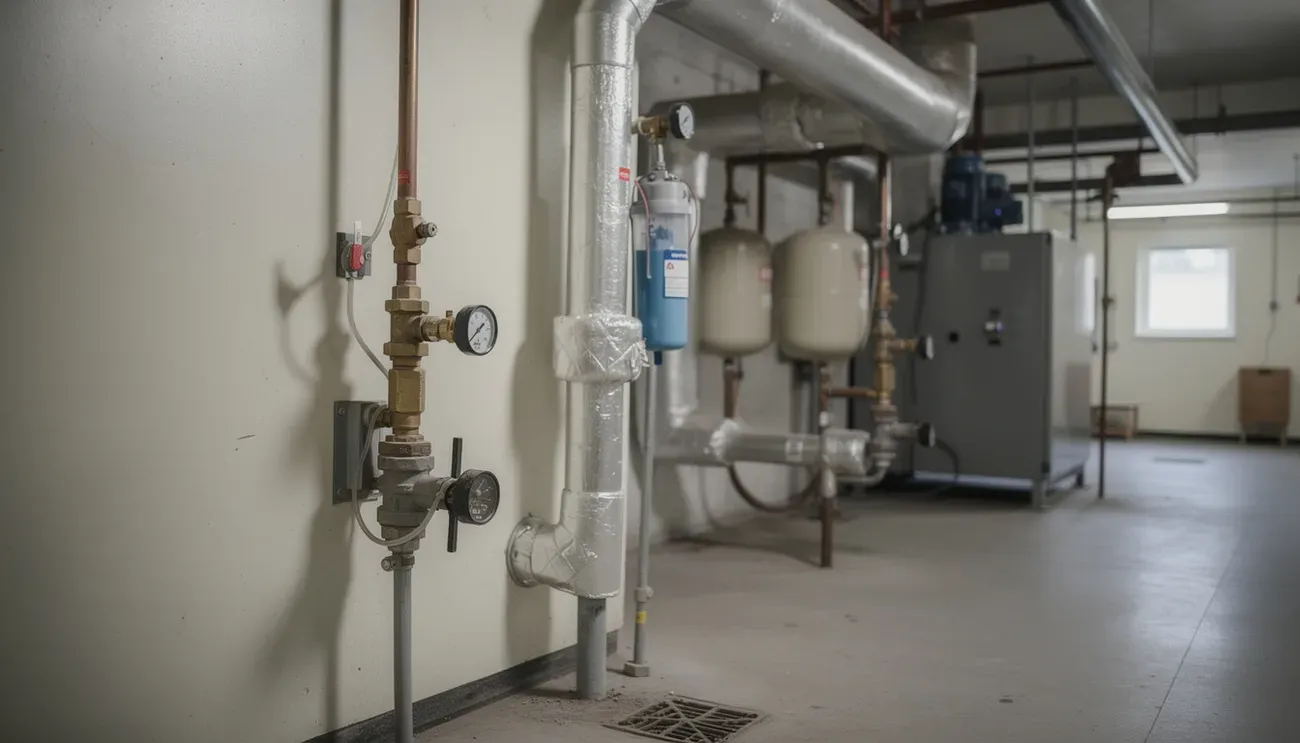
The by-law defines institutional as buildings used by an organised body, society or religious group for a public or non-profit purpose. Schools, places of worship, community centres, care and retirement homes, and government buildings all sit inside the program, usually with a DCVA on the domestic service and RPZs on boiler and kitchen lines.
What the by-law means by institutional
Section 1.1(r) of By-law 24-2018 defines institutional as lands, buildings or structures used by an organised body, society or religious group for promoting a public or non-profit purpose, including accessory office uses. Section 3.1 applies the by-law to every institutional property supplied with Regional water. In Durham that takes in:
- Public, Catholic, French-language and independent schools; colleges and their satellite campuses
- Churches, mosques, temples, gurdwaras, synagogues, halls and parish centres
- Community centres, arenas, libraries and municipal buildings
- Long-term care, retirement and group homes
- Charities, service clubs and non-profits with their own buildings
Each has a premise isolation device on record with the Region, tested every year by an authorized tester, at the owner’s expense (section 6.3). Many have more than one device.
What devices institutional buildings usually have
| Building | Typical devices |
|---|---|
| Elementary school | DCVA on the domestic service; RPZ on the boiler make-up; PVB on field irrigation if any |
| Secondary school | The above plus RPZs on science labs, cafeteria kitchen, auto or tech shops, pool chemical feed |
| Place of worship with a hall | DCVA on domestic; RPZ on the kitchen line if there is a commercial kitchen; RPZ on boiler make-up |
| Community centre or arena | RPZ on ice plant and refrigeration make-up, RPZs on kitchen and pool systems, DCVA on domestic |
| Care or retirement home | DCVA on domestic; RPZs on boiler, kitchen and laundry chemical feeds; sometimes zone devices per wing |
Each device is tested separately and reported separately. The notice lists what the Region has on file. If you are not sure how many you have, send the notice and we tell you.
Who handles it, and the timing that works
School boards typically manage backflow across dozens of buildings from a central facilities office. The useful thing we can offer is a Region-wide schedule for the Durham schools in one board, timed to PA days, March break, and summer, with one register of devices, dates and results at the end. If a board already has a tester under contract, we are happy to be the second option for overflow or specific sites.
Independent schools, places of worship and non-profits usually have a property committee, an operations lead, or a volunteer treasurer holding the notice. For these buildings the practical points are: who has the mechanical room key, when the building is empty for an hour, and where the last report is. Weekday daytime for a church is often ideal; after dismissal or a PA day for a school.
Care and retirement homes cannot simply lose water. Zone devices are tested line by line; the premise device is tested in the quietest window (often very early morning) with nursing and kitchen staff informed. We plan it with the maintenance lead.
Budget and records for a committee or board
Testing is priced per device with the visit shared. Repairs, if a device fails, are separate and quoted first, and done by a licensed plumber. For a committee that meets monthly, we can send a one-page summary after each cycle: devices on file, test dates, results, filing confirmations, and anything flagged for next year. Reports must be kept on site for five years under section 6.6; a folder in the office or a PDF in the shared drive is fine.
Fields, grounds and the spring test
Schools, churches and community centres with irrigated fields or grounds have a PVB or DCVA on the irrigation line, tested at spring start-up when the system is pressurised. That device has its own record and often its own notice, with a spring anniversary. See the irrigation page.
What we do not do for institutional buildings
Fire sprinkler line devices (section 9.1 of the by-law requires personnel approved by the Commissioner), the five-year cross-connection survey (plumbers, engineers and technologists), and repairs. If a notice asks for a survey or an install, a plumber acts first and we test afterwards.
Schools, churches and institutions: questions
Is a church covered by the backflow by-law?
Yes. Section 1.1(r) defines institutional as buildings used by an organised body, society or religious group for a public or non-profit purpose, and section 3.1 applies the by-law to institutional properties on Regional water. A church, mosque, temple, gurdwara or synagogue with a Regional water connection has a premise isolation device on record and an annual test.
Who deals with it at a school?
For public and Catholic boards, usually the board's facilities department, which may already run a Region-wide program across many schools. For private and independent schools, the head of operations or the property committee. Notices go to the owner of record, which for a board school is the board.
When is a good time to test a school?
PA days, March break, summer, or after dismissal. The premise device takes water off the building for up to an hour, so it should not overlap with occupancy. Irrigation devices on fields are tested at spring start-up.
A retirement home cannot lose water for an hour. What then?
Tell us the layout. Care homes often have zone devices whose lines can be isolated one at a time, and a premise device that can be tested in the quietest overnight or early-morning window with the facility's staff informed. We plan it with your maintenance lead rather than imposing a slot.
Tell us the building and the calendar
School, place of worship, community centre or care home: send the address, the contact, and the quiet windows. We book, test, tag and file around them.