Backflow testing for industrial and manufacturing sites
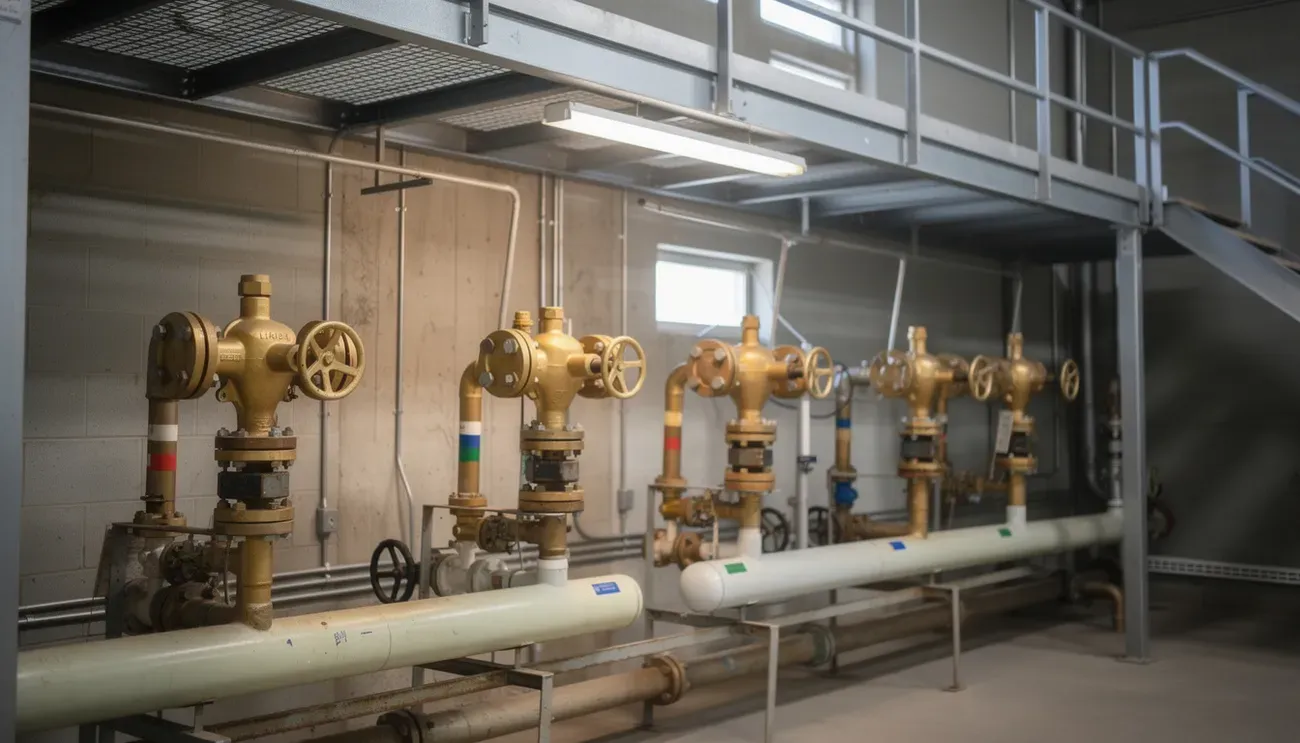
Industrial properties are usually the buildings with the most devices: an RPZ on process water, another on boiler make-up, a DCVA on the domestic service, sometimes zone isolation on a wash bay or a lab. Each is on the Region's record and each is tested annually. The by-law defines industrial broadly, and it includes the accessory office and warehouse space.
What “industrial” means under the by-law
Section 1.1(q) of By-law 24-2018 defines industrial as land, buildings or structures used for manufacturing, producing, processing, fabricating or assembly of raw goods, research or development, including office, warehousing and bulk storage uses that are accessory to it. So the plant, the attached office block, and the warehouse are one industrial property with one owner responsible under the by-law.
Industrial sites are where hazard classification bites hardest. Process water, chemical feed, boiler treatment, cooling towers, wash bays and labs are severe hazards under CSA B64. The Region’s survey of your site identified each cross-connection and the device protecting it, and every one of those devices is on record for annual testing.
The devices you probably have
| Where | Typical device | Why |
|---|---|---|
| Incoming water service (premise isolation) | RPZ, or DCVA if the site as a whole is moderate hazard | Protects the municipal main from everything inside |
| Boiler make-up | RPZ | Chemical treatment on the water side |
| Process water loops | RPZ (zone isolation) | Process chemicals, non-potable loops |
| Cooling towers, chillers | RPZ | Biocides, scale inhibitors |
| Wash bays, vehicle wash | RPZ | Detergents, recycled water |
| Labs, QA rooms | RPZ | Chemical and biological hazards |
| Domestic (washrooms, lunchroom) where separated | DCVA | Moderate hazard |
| Irrigation | PVB | Backsiphonage on outdoor lines |
Each device is tested to CSA B64.10.1, tagged, and reported separately. The device pages explain what each test checks and why each type fails.
Scheduling around production
The premise device takes water off the whole site for the readings, roughly 30 to 60 minutes. Zone devices take only their line down. So the plan is usually:
- Zone devices during a shift, one line at a time, coordinated with the area lead.
- The premise device between shifts, during a planned outage, or on a weekend. Early morning before first shift is the most common slot.
- Everything on one visit where the site allows, so there is one interruption plan and one set of reports.
Tell us about lockout/tagout, confined space, elevated work, PPE, and sign-in requirements when you book. The tester follows your site rules and arrives with what the locations need.
Process changes and the survey
Section 5.3 (as amended May 2026) requires a new cross-connection survey every five years and again on any tenant or ownership change, re-zoning, or change of process or chemical use. On an industrial site that happens more often than people expect: a new line, a new coolant, a new wash bay. The survey is done by a licensed master plumber, professional engineer or certified engineering technologist (Appendix A); it may result in an install notice for a new device or an upgrade. We do not do surveys, but when the tester sees a connection with no device or the wrong device, you hear about it plainly.
When a device fails on an industrial site
The tester notifies the Region within 24 hours (section 6.4), and repair or replacement proceeds immediately at the owner’s expense. On a plant, that often means your own maintenance department if they hold a tester’s licence (Appendix A row C allows in-house staff with a licence to repair), or a licensed plumber otherwise. We coordinate whichever you prefer and return for the retest. Devices may not be bypassed without the Commissioner’s authorization (section 6.7), which matters when a process line cannot wait; talk to us and the Region before anyone opens a bypass.
Records
Five years of test reports on site (section 6.6), one per device per year. For a multi-device site that is a stack of paper; we can supply a device register per cycle listing every device, its location, test date, result, and filing confirmation. It is what an auditor, an insurer, or a new plant manager wants on day one.
Industrial and manufacturing: questions
How many devices does an industrial building usually have?
More than one. A typical plant has a premise isolation device on the incoming service (often an RPZ if the whole site is severe hazard), plus zone isolation devices on specific lines: boiler make-up, process water, wash bays, labs, cooling towers, irrigation. Each one the survey found is on the Region's record and each is tested annually. The notice lists them.
We changed a process line. Does that matter for backflow?
Yes. Section 5.3 of the by-law requires a new cross-connection survey on any change of process or chemical use, because the hazard classification may change and a device may need adding or upgrading. The survey is done by a plumber, engineer or technologist. The annual test on existing devices continues regardless.
Can you test during production?
Devices on branch lines can often be tested with only that line down. The premise device on the main service takes water off the whole site for up to an hour, which usually means between shifts, during a planned outage, or on a weekend. Tell us the layout and the shift pattern and we plan around it.
Some of our devices are up on mezzanines or in tight spaces. Is that a problem?
It affects time, not whether it can be done. Tell us in advance about ladders, lifts, confined spaces or lockout requirements so the tester arrives with what is needed and your safety procedures are followed.
What is zone isolation versus premise isolation?
Premise isolation is the device on the incoming water service protecting the municipal main from the whole property. Zone isolation is a device on a section of piping inside the building that has only non-potable connections (a process loop, say). Section 6.9 lets the Commissioner approve zone or area isolation in place of premise isolation in defined cases. Most plants have both kinds, and all are tested.
Send the device list, or let us build it
Site address, the notices you have, and the shift pattern. We test every device on one visit and file every report.