What Is a Cross-Connection, and Why Does Durham Region Care?
A cross-connection is any point where drinking water meets something that is not drinking water. What that means in a real building, how water flows the wrong way, and why the Region has a by-law.
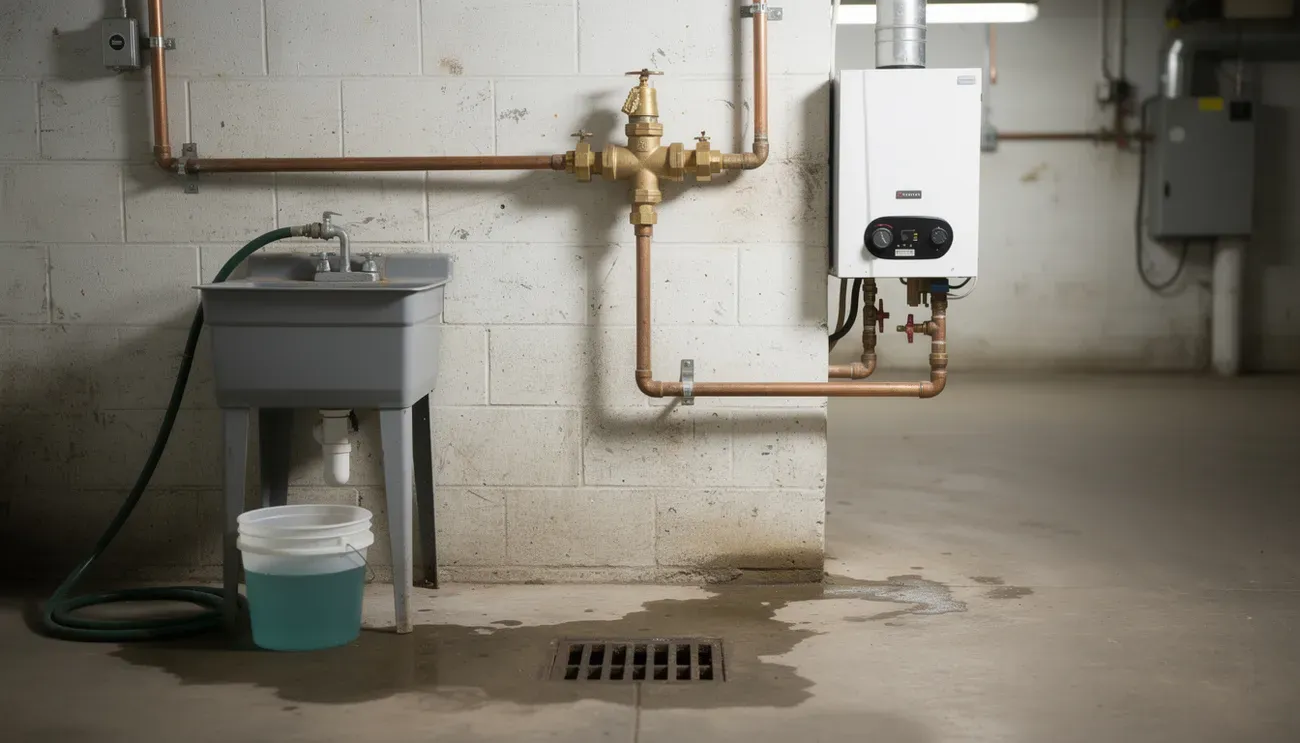
Every building that uses water for anything other than drinking has cross-connections. A boiler, a dish machine, a lawn sprinkler, a mop sink with a hose on it: each is a place where the drinking water supply touches something you would not want to drink. That is not a defect. It is how plumbing works. The question the Region’s by-law asks is whether each of those points is protected so that water can only ever move one way.
The definition, in the by-law’s words and in plain ones
Section 1.1(k) of By-law 24-2018 defines a cross-connection as “an actual or potential connection between a potable water system and any source of pollution affecting any temporary, permanent, or potential water connections that may allow backflow to occur.” Backflow (section 1.1(e)) is “a flowing back or reversal of the normal direction of water flow.”
Plainly: a cross-connection is anywhere clean water meets not-clean water. Backflow is the not-clean water going the wrong way, back toward the tap and the municipal main.
What is on the other side of the connection
Some everyday examples in Durham buildings:
| Where | What is on the plumbing |
|---|---|
| Boiler room | Corrosion inhibitors, glycol, biocides in the boiler water |
| Commercial kitchen | Carbonated beverage system (CO2 and copper), detergents and sanitisers in the dish machine, grease |
| Dental office | Dental unit water lines, suction systems, steriliser drains |
| Car wash | Detergents, waxes, recycled wash water |
| Irrigation | Soil, standing water, fertiliser |
| Cooling tower | Biocides, scale inhibitors |
| Any hose bibb with a hose left in a bucket | Whatever is in the bucket |
The by-law sorts these by hazard. Severe hazard (section 1.1(p)) is anything with additives or substances that under any concentration can create a danger to health. Moderate hazard (section 1.1(s)) is a connection where the water’s aesthetic qualities are reduced and could, under some conditions, be a health risk. The classification decides which device is required: a reduced pressure principle assembly (RPZ) for severe, a double check (DCVA) for moderate.
How water actually flows the wrong way
Two mechanisms.
Backsiphonage. Pressure in the municipal main drops. A watermain break down the street, a hydrant opened for firefighting or flushing, a big draw during a peak. Water in your building’s pipes is now at higher pressure than the main, and it gets sucked backward, taking whatever is at the open end with it. A hose in a bucket becomes a straw.
Backpressure. Pressure on your side rises above the main. A booster pump, a boiler heating water, a tall building’s elevated piping, a well or process system connected to the same plumbing. Water is pushed backward.
A backflow preventer is a mechanical answer to both: spring-loaded checks that only open toward the building, and (on an RPZ) a relief valve that dumps water to a drain rather than let it move backward. Our devices page explains the three types.
Why the Region cares enough to have a by-law
The recitals of By-law 24-2018 make the reasoning explicit. The Region operates its drinking water systems under the Ontario Safe Drinking Water Act, 2002, which makes it an offence to cause or permit anything to enter a drinking water system that could create a drinking-water hazard. The Region has treatment plants, storage, watermains and testing to keep water safe from the source to the property line. A cross-connection inside a building bypasses all of it: the contamination enters after treatment, at the last step, and can travel back into the main and out to neighbours.
The Region’s program page lists Canadian incidents that shaped the approach: petroleum in Guelph’s water in 1997 affecting tens of thousands of residents, blue caustic water in Edmonton in 2002, pink water and a two-day outage in Stratford in 2005, a school closure in Oakville in 2011 after chemicals were detected. Each traced back to a cross-connection. The by-law calls backflow prevention part of the Region’s “multi-barrier approach.”
What the by-law actually requires of an owner
Three things, in order:
- A survey. A cross-connection survey of the plumbing, done by approved personnel (licensed master plumbers, professional engineers, certified engineering technologists per Appendix A), within 90 days of the Region’s request, and again every five years or on ownership, tenant, re-zoning or process changes (sections 5.1 to 5.3). The survey finds the cross-connections and classifies the hazards.
- A device. Where the survey finds a hazard, a backflow preventer for premise isolation on the water service, installed within 180 days of notification (sections 3.3, 6.1, 6.2). Sometimes zone or area isolation devices inside the building as well.
- An annual test. Every device tested annually by an authorized tester, with the report filed with the Region (sections 6.3, 6.5). That is the part this site is about.
What you can do about cross-connections yourself
Not the survey and not the test, but the small stuff:
- Never leave a hose end submerged in a bucket, sink or pool. Fit hose bibb vacuum breakers on outdoor taps.
- If a relief valve on an RPZ is discharging, do not plug it. It is doing its job; the device needs service.
- Tell whoever manages compliance when a tenant or process changes. Section 5.3 says that triggers a new survey.
- Keep the mechanical room accessible so the device can be tested and seen.
Where this leaves you
If you have a backflow preventer, you have a cross-connection somewhere behind it, the Region knows about it, and it is due for a test once a year. The notice page explains the letter that reminds you; the service page explains the test.
Questions this raises
Is a cross-connection illegal?
An unprotected one is. Section 4.1 of By-law 24-2018 prohibits any connection that could let non-potable water or any other liquid, chemical or substance enter the drinking water system. Cross-connections themselves are unavoidable in a working building; the by-law requires them to be identified and protected by a backflow preventer.
What is the difference between backsiphonage and backpressure?
Backsiphonage is water being pulled backward because pressure in the main dropped (a main break, hydrant use). Backpressure is water being pushed backward because pressure on the building side rose above the main (a pump, a boiler, elevated piping). Different devices protect against one or both.
Who finds the cross-connections in my building?
The cross-connection survey, done by a licensed master plumber, professional engineer or certified engineering technologist under Appendix A of the by-law, every five years and on ownership, tenant, or process changes. The survey report tells the Region what hazards exist and what devices protect them.